The 10-Minute AI Tool Audit Every Clinician Should Run
Aug 13, 2026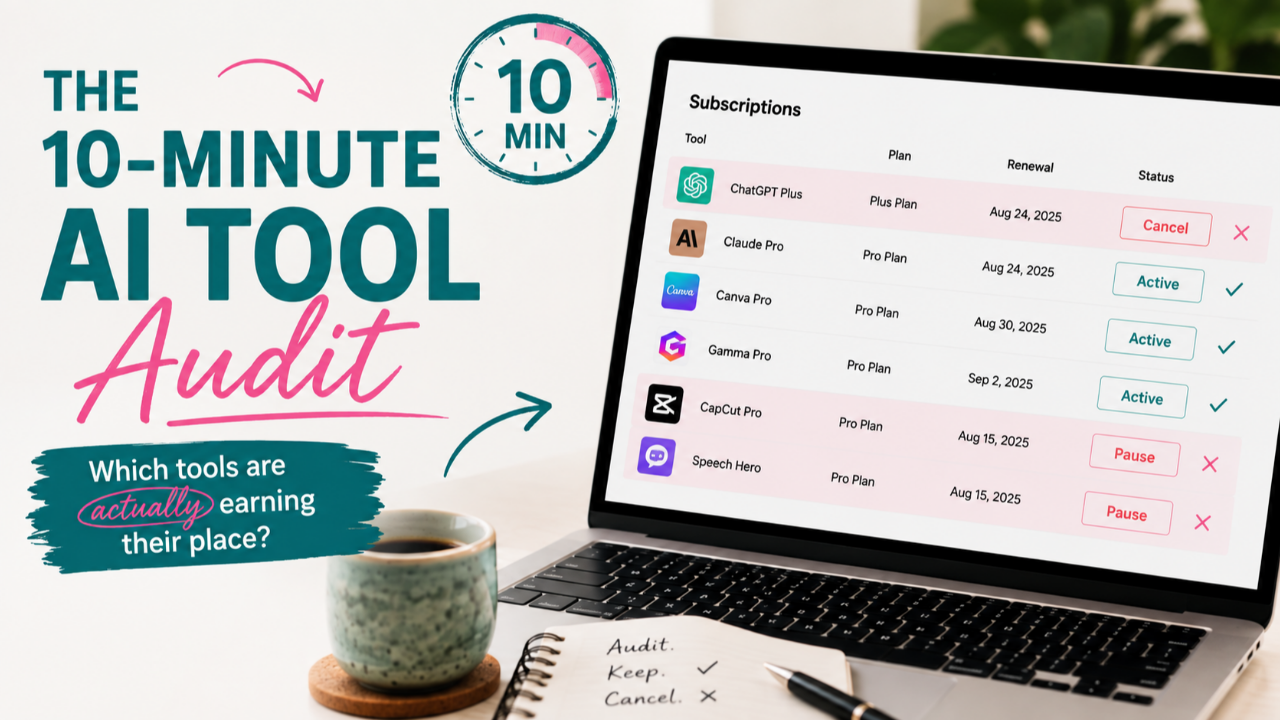
The 10-Minute AI Tool Audit Every Clinician Should Run
I recently closed my ChatGPT subscription. Not because it stopped working, but because I was predominantly using Claude, and paying for both stopped making sense.
That single decision made me sit down and actually audit the rest of my AI stack. It took about ten minutes, and I found two tools I was paying for and not using at all.
Here's the audit, and why it's worth running on your own practice.
How Do You Know When an AI Tool Has Stopped Earning Its Place?
Two questions, most weeks. Nothing complicated.
-
How often am I actually opening this?
-
Is something else in my stack already doing this job?
CapCut and Speech Hero were the easy calls for me.
Neither was doing a job for me anymore, so they went. The budget I was spending on both went straight into upgrading the tool I was actually using.
What Happens When AI Tools Overlap?
The harder question isn't the tool you've stopped opening. It's the tools you're still opening that might be solving the same problem twice.
I'm working through that one right now with Gamma, Canva and Claude. All three are capable of overlapping creative and admin tasks, and I'm assessing which one earns the spot for which job rather than running all three out of habit.
If you're stuck at that overlap question, search the AI Tool Library by task rather than by tool name. It's built to show you what's actually doing the job for your caseload, not just what's popular. That's a different problem to the one most AI content assumes you have. Most speech pathologists I work with aren't AI-naive. The gap isn't awareness, it's discovery and fit.
Why Does Tool Fit Matter More Than Tool Adoption?
A Victorian practice reached out to me recently after trialing AI across their documentation, then pulling back. That's often less about the tool itself and more about fit.
Using AI well means choosing a stack that actually supports your practice, the way you work, and your own clinical priorities and values. Get that starting point wrong, and it's easy to see how clinical reasoning can quietly erode instead of staying sharp.
That's why getting help with where to start matters, before you're three subscriptions deep into tools that don't fit your caseload.
Frequently Asked Questions
How often should I audit my AI tool stack?
There's no fixed schedule. If you can't remember the last time you opened a tool, that's a strong signal it's time to look.
How do I know if two tools are doing the same job?
Look at what each tool is actually producing for you, not what it's marketed to do. If two tools are solving the identical problem in your workflow, you likely only need one.
Where do I find AI tools that actually fit my speech pathology caseload?
Search the Speech Pathology AI Tool Library by task, not by tool name. It's built for discovery and fit, not for adding to a list of tools you've already heard of.
What if my team has already tried AI and pulled back?
That's usually a fit problem, not an AI problem. Getting support with where to start, rather than which app to download, tends to be the difference.
Where This Fits Into Your Practice
Running your own version of this audit is a ten-minute task, not a project. If you want support figuring out which tools genuinely fit your caseload, or want help building your team's AI skills one step at a time, that's what bespoke workshops and mentoring are for.
https://www.speechpathologyresources.com.au/services
Shae Rodgers
Neurodivergent Speech Pathologist and AI Educator