Building an AI Tech Stack for Speech Pathology: Why One Tool Is Never Enough
Aug 05, 2026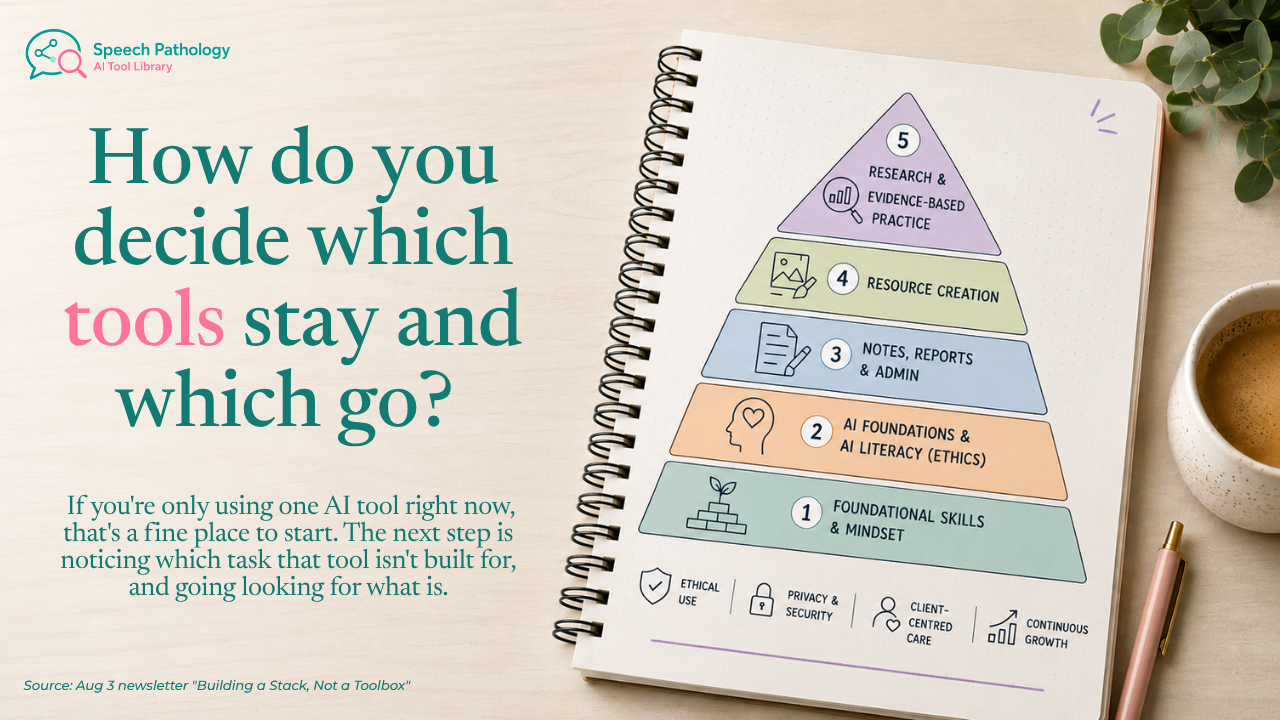
Why do speech pathologists need more than one AI tool?
A real caseload doesn't ask one kind of question. A preschooler working on social skills needs something different to a telehealth client who needs a differentiated worksheet. Expecting one AI tool to cover both is the same as expecting one assessment to cover every client.
What does a real AI tool stack look like in practice?
This week I made a weather matching activity for an AAC client working on early literacy. I built it in Claude first, a printable version with integrated symbols for her Velcro board. Then I turned the same activity into an HTML game, just to see how the digital version landed against the paper one. Same skill, same client, two different builds.
I used Diffit AI to generate a worksheet for a telehealth client, and Ella Kids AI for a social story with a preschooler on a different goal entirely.
How do you decide which tools stay and which go?
My stack shifts constantly. I'm always trialing something new, subscriptions on and off, as I test what actually earns a permanent spot. A tool stays because it solved a real problem, not because it's new. The tools in my current stack are Diffit AI, Glint AI, Canva, Claude, Chat GPT, Heidi Health, Halaxy, Ella Kids, Tellumi & wispr flow.
Where can I find AI tools other speech pathologists are actually using?
The Speech Pathology AI Tool Library is free to search. It's organised by task, not by hype, so you can search "social stories" or "worksheet generator" and see what's actually being used for that specific need.
If you're only using one AI tool right now, that's a fine place to start. The next step is noticing which task that tool isn't built for and going looking for what is.
Search the Tool Library: https://speech-pathology.ai